Member States and Tribes working together to reclaim the Nation’s abandoned mine lands.

Spring 2026 Newsletter

Reclamation Poster

2027 Winter Business Meeting

2027 Fall Conference and Business Meeting
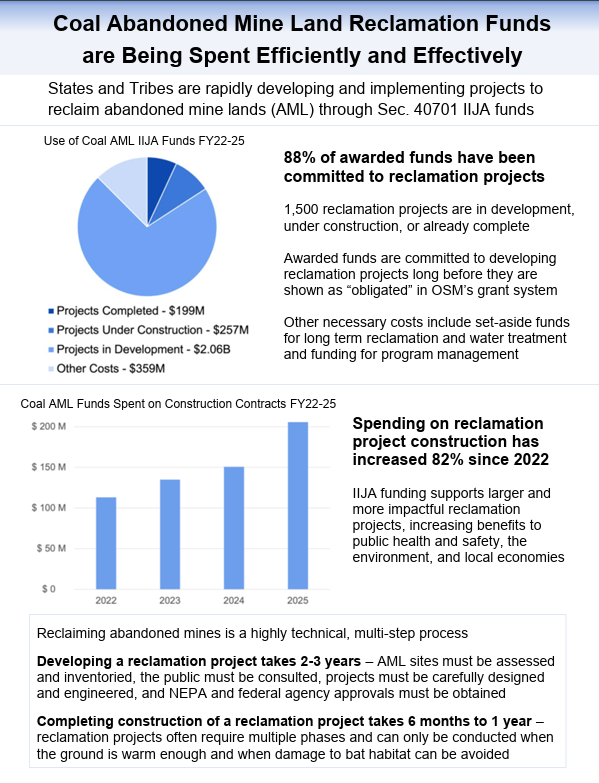
Coal Abandoned Mine Land Reclamation Funds are Being Spent Efficiently and Effectively
States and Tribes are rapidly developing and implementing projects to reclaim abandoned mine lands (AML) through Sec. 40701 IIJA funds

2026 Hardrock Awards
The National Association of Abandoned Mine Land Programs is seeking nominations for the 2026 Hardrock Abandoned Mine Lands Reclamation Awards. These awards aim to recognize outstanding projects in two categories:
1. Remediation of contamination that impacts the environment or human health.
2. Remediation of physical safety hazards at legacy abandoned hardrock mines in the United States.

Hardrock Abandoned Mine Hazards:
An Overview of Impacts and Solutions
IMCC-NAAMLP
-
FOR IMMEDIATE RELEASE
December 10, 2025
New Report Reveals Staggering Scale of Nationwide Hardrock Abandoned Mine Problem
National organizations call for increased funding to clean up dangerous, pre-regulation era mining hazards
The Interstate Mining Compact Commission (IMCC) and the National Association of Abandoned Mine Land Programs (NAAMLP) released a new report, "Hardrock Abandoned Mine Hazards: An Overview of Impacts and Solutions," highlighting the staggering scale of the problem leftover from the historic, pre-regulation era of mining. Across the nation, there are an estimated 1.8 million hazards from hardrock abandoned mine lands (AML), with at least 750,000 posing immediate danger to people and the environment.
“Abandoned mines pose physical and environmental hazards in every region of the country. Dangers like open mine shafts, surface subsidence, and deadly gases kill and injure people every year. Toxic water runoff or interaction with surface waters from abandoned mines impacts ecosystems. The cleanup of abandoned mine sites provides significant economic opportunities for local communities and restores the ecosystems,” said Robert Ghiglieri, Administrator at the Nevada Division of Minerals and NAAMLP Hardrock AML Committee Chair.
This landmark report marks the first time the full scope of the national hardrock AML problem has been explained and accounted for in one place. The report estimates $11 billion is needed for physical safety hazards and $50 billion for environmental hazards.
Currently, funding for state and federal agency hardrock AML programs is scant. What funding is available is patched together from various limited sources with little national-level support. A national funding mechanism was recently created as part of the U.S. Department of Interior’s new Abandoned Hardrock Mine Reclamation program, but it has only received about $5 million annually the last few fiscal years, falling short of the estimated billions needed.
Member states of IMCC and NAAMLP have made the most of limited resources and shown the benefits of cleaning up hardrock AML hazards. The report highlights examples of successful hardrock AML projects in Arizona, California, Colorado, Nevada, and Wyoming. In Arizona, remediation of acidic mine polluted water resulted in fish returning to a creek, even before the project was complete. In Wyoming, a state park was created at a historic mine site that now educates thousands of school children about the state’s history of mining.
The report emphasizes that funding is what is most needed to create more of these kinds of success stories, but it also recommends other steps Congress and the federal government should take, including:
Expanding the federal Good Samaritan hardrock AML pilot program created in 2024 - This program allows state hardrock AML programs to restore historic mine polluted water without incurring undeserved liability. It also allows third parties without connection to AML sites, such as Trout Unlimited or mining companies, to partner with state and federal agencies to fund AML projects.
Facilitating critical minerals extraction from historic mine waste - Mine waste at AML sites often contains rare earth elements and other minerals essential to powering modern society. Through partnerships with state hardrock AML programs, universities and private firms are developing the technology to recover these minerals while cleaning up the sites in the process.
Continuing development of a national hardrock AML inventory - The U.S Geological Survey (USGS) is gathering information on hardrock AML hazards from state and federal agencies to be consolidated for the first time in one national inventory database. This effort will require additional funding alongside funding for state and federal agency hardrock AML programs to continue surveying the sites on the ground. The IMCC and NAAMLP report estimates that for every mine hazard identified in the current USGS database there are between three and ten hazards on the ground.
Allowing state hardrock AML programs to take the lead - State agencies are in the best position to address the hardrock AML problems within their borders. They can work on private and state land and, as is common practice, cooperate with federal agencies on federal land. State agencies have the local-level expertise and relationships with communities and stakeholders that are the key to a successful AML program. This kind of state-led approach has been successfully utilized in the long-standing coal AML program under the Surface Mining Control and Reclamation Act.
IMCC and NAAMLP urge Congress to fully realize the immense, multi-faceted benefits of full funding and support for the Abandoned Hardrock Mine Reclamation program and the Good Samaritan program. Doing so will protect and revitalize communities across the country, restore impacted ecosystems, and provide access to domestic sources of critical minerals.
“The goal of this report is to highlight that fixing the hardrock AML problem should be a national priority. We hope it will give Congress the information they need to act,” said Ryan Ellis, IMCC Director of Legislative and Regulatory Affairs. “The pieces are in place; the state and federal agencies that do this work are ready to go. Now we just need to fund them.”
Contact:
Ryan Ellis, IMCC Director of Legislative and Regulatory Affairs
Ph: (703) 674-8350
Email: Rellis@imcc.isa.us
IMCC is a multi-state governmental organization supporting the natural resource and related environmental protection and mine safety and health interests of its member states.
NAAMLP isan association fostering cooperation among state and tribal AML programs to support the reclamation oflands impacted by abandoned mines.

Connect with us on LinkedIn